
Case study
A year in WordPress. Ninety days the second time, thirty of them with us. Same idea, same person.
Living in Duvall, Washington. Built by Buddy Buck, a real estate broker, for a town of about eight thousand people. Free for everyone who lives there. What the monthly engagement produces.
Where it started
He wanted to build the town a website. So he did, by himself.
Buddy Buck sells real estate in Duvall. He was Vice President of the Duvall Chamber of Commerce when he had the idea: build a brand for the town itself, a place where the businesses, the events and the people who wanted to help could all be found, and let it do two things at once. Position him as somebody who serves the community, and bring the leads to him.
He built the first version himself, on a WordPress template. It took him about a year, and it could only do so much.
The call that changed it
He expected a year to build it and a burden to run it. It took ninety days, and it takes two hours a week.
What he expected
A year to build, at least. And the bigger it got, the more of my week it would take.
That was a reasonable expectation. The first version had taken him a year, and it was small. He still uploaded every business listing and every event by hand. Every feature he had ever added had meant more of that, so a version that did far more looked like far more work.
What happened
Ninety days to launch. About two hours a week to run.
Thirty days of training with us produced a working prototype. Sixty days of his own alpha and beta testing produced the launch. Moderation included, at a scale that could reach everyone in town. Same person, same idea, two attempts, and the second one is both the larger and the lighter.
Why
The work moved from him to the system.
The listings and the events gather themselves now. What is left for him is deciding what stays up, which is the part that needs a person who knows the town. A bigger site had always meant a heavier one. This is the case where it did not.
- To build and launch it
- 90 days
- thirty of training, sixty of his own testing, after a year on the first version alone
- To run it
- About 2 hours a week
- moderation included, for a whole town
Ninety days
Thirty days produced a working prototype. The next sixty were his.
The first thirty days were training with us, building the new Living in Duvall together as a progressive web app, and they ended with a working prototype. The next thirty were his alpha testing. The thirty after that were beta. Ninety days from the start, it launched. It is the same idea he had spent a year on, and it does the things the first version could not.
A directory that fills itself
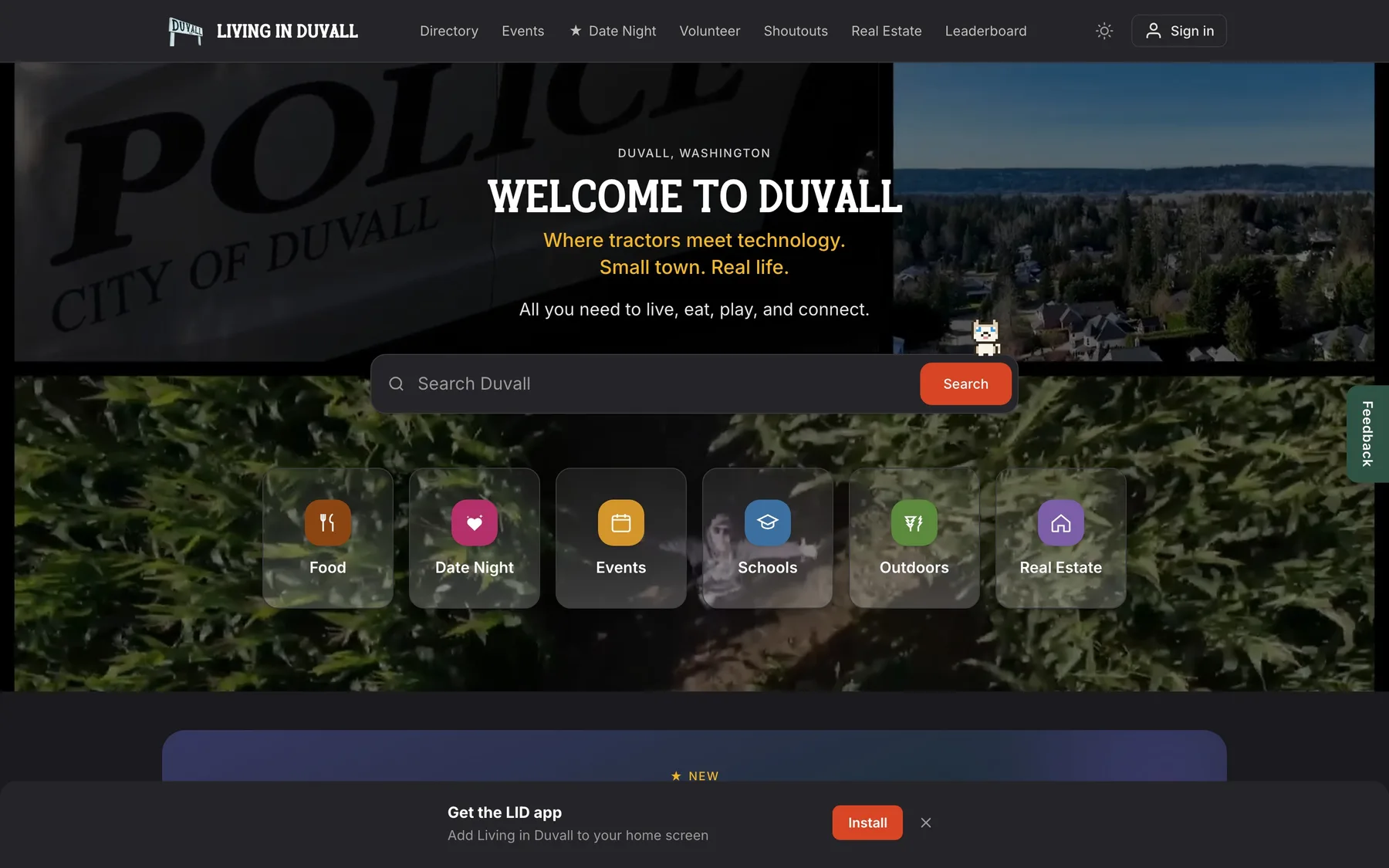
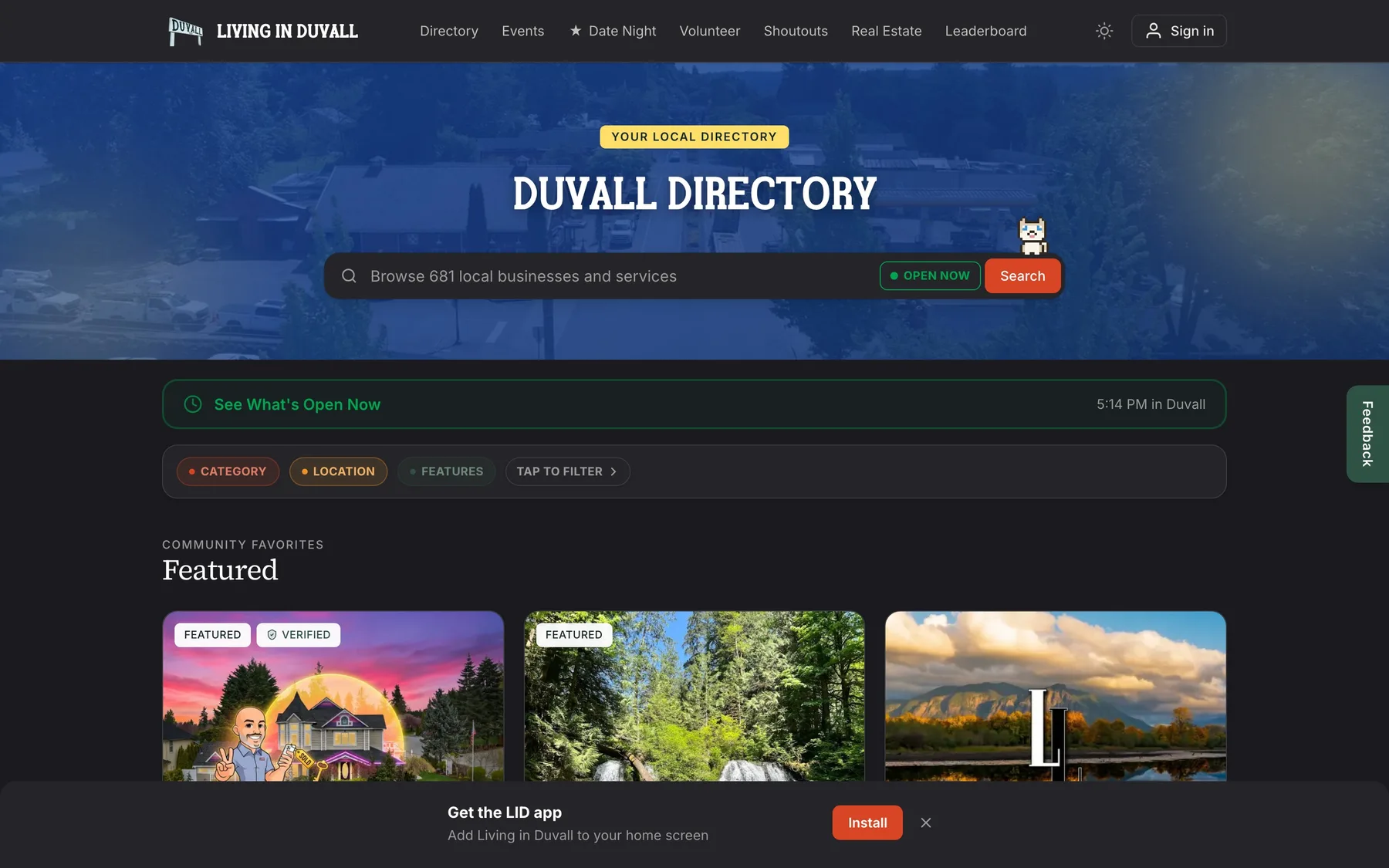
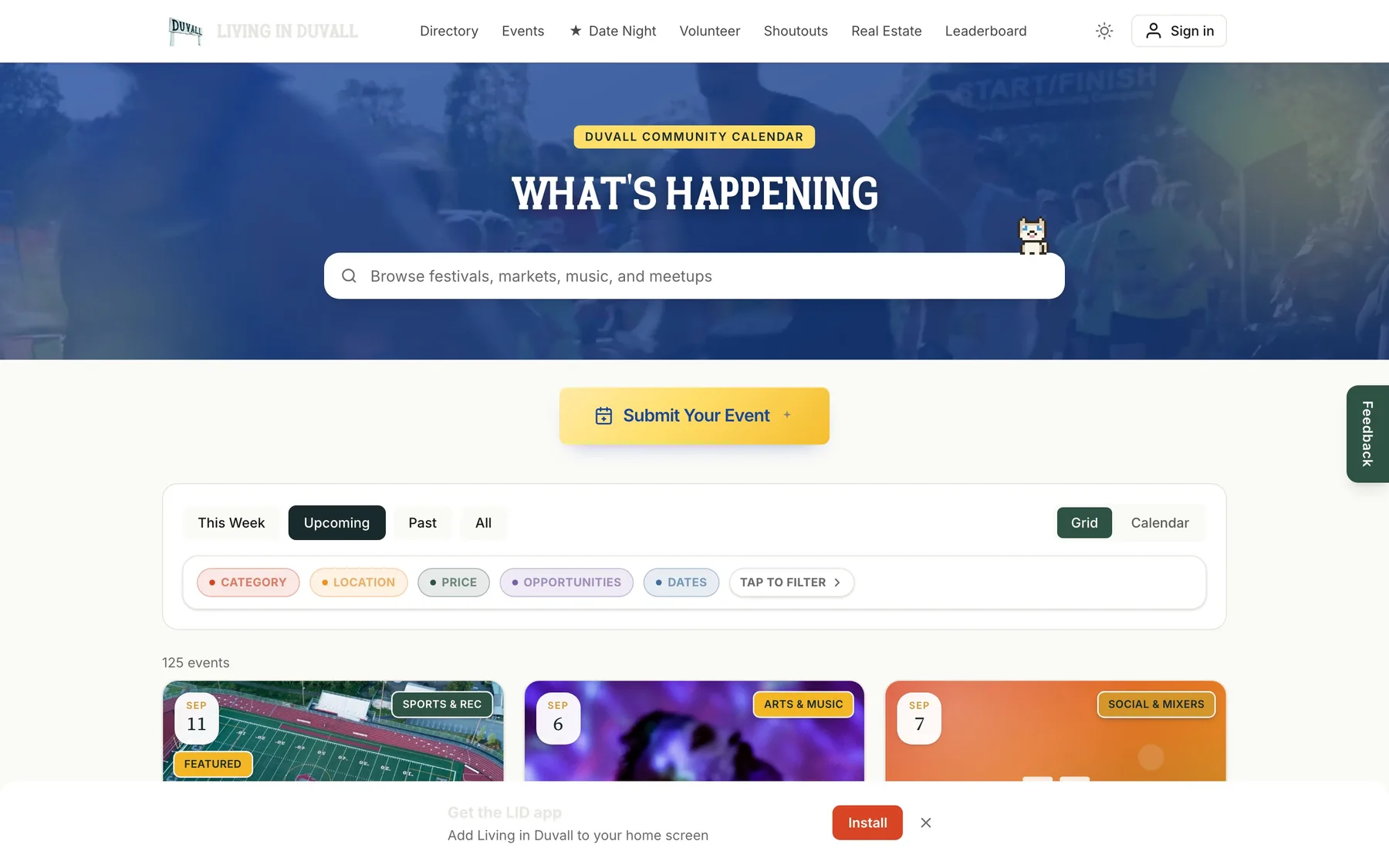
Business listings and community events are gathered automatically, so the site stays current without anyone keying them in.
Volunteers matched to the people who need them
Anyone who wants to volunteer is paired with the nonprofits, schools and events looking for help.
Everything a town asks, in one place
Events, a date night planner, drive times, and whether the 124th Street bridge is open right now. The questions people in Duvall already have, answered where they look.
An app on the phone, not a bookmark
Built as a progressive web app, so it installs to the home screen and opens like anything else there.
Go and look
livinginduvall.com, the version the town uses.
The directory, the calendar, and the prompt to put it on a phone. Every one of these screens is the second attempt.

What it became
The mayor gave them an hour. The Chamber put it in front of the room.
Businesses, nonprofits, schools and organisations across Duvall are listed on it together. The mayor of Duvall met with Buddy and Brett for an hour about it, and the city now promotes it on its own website. The president of the Chamber of Commerce presented it to the Chamber.
Nobody in Duvall pays to use it. Not the businesses listed, not the nonprofits looking for volunteers, not the people looking for something to do on a Friday. It is a gift to the town from the man who sells houses in it.
Why this works
He is not advertising in Duvall. He is the infrastructure Duvall runs on.
An advertisement asks for attention and people learn to look past it. A utility gets used, every day, by people who are not thinking about who made it until the day they need an agent and realise they already know one.
The businesses in the directory, the nonprofits finding volunteers, the families checking whether the bridge is open, are all on a platform with his name behind it. Nobody feels sold to. The leads come anyway. That is the whole argument of this site, taken as far as it goes: become the name a place already knows, and the finding takes care of itself.
What this is an example of
The monthly engagement, at $4,500 a month.
Living in Duvall is free for the town. It was not free to build. It is what the training inside the managed engagement, and sixty days of his own work after it, produced for one client who arrived with an idea and a year of trying. Buddy owns livinginduvall.com outright.
The training was thirty days and the build was ninety. The engagement continues, and what it buys now is help growing what he built and owns.
If you live in Duvall, or are thinking about it
Go and use it.
Where to eat, what is on this weekend, who needs a hand, and whether the bridge is open. Built by your neighbours, as the site puts it, and free to everyone who lives there.
If this sounds like you